
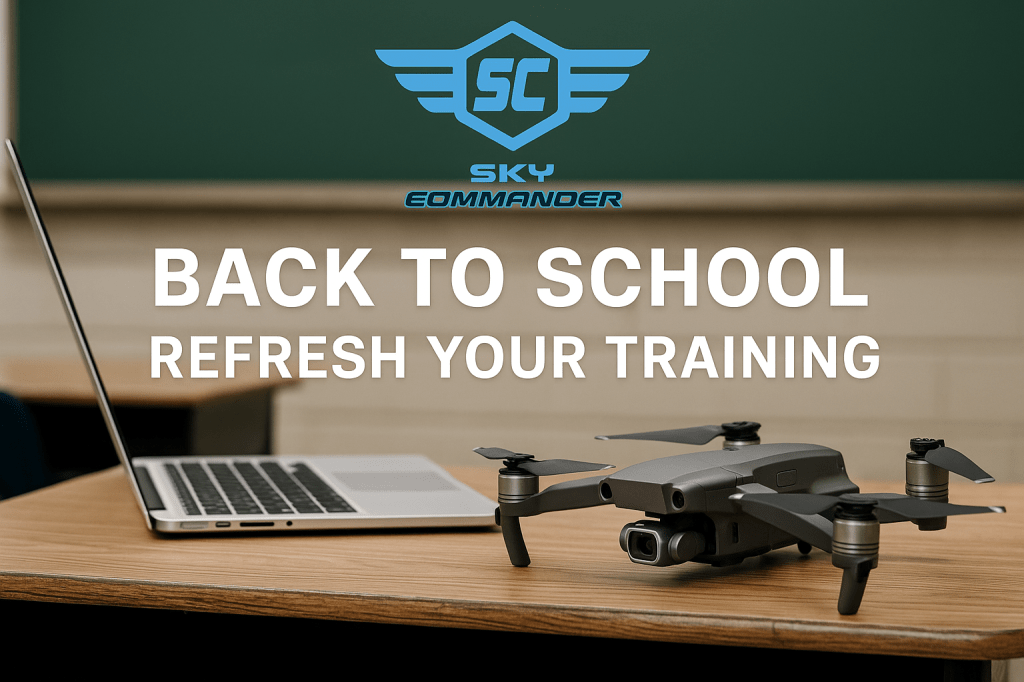
Sharpen your edge this fall — knowledge is your ultimate flight plan
Why It Matters
September isn’t just for students — it’s for pilots, too.
Drones are evolving faster than ever: BVLOS rules roll out in November, Transport Canada updates continue, and competition for paid flight work is heating up. If you’re not updating your training this fall, you’re falling behind.
Here’s the truth: safe flying isn’t just about muscle memory or logging hours. It’s about being exam-ready, regulation-ready, and contract-ready. The pilots who build training habits now will be the ones cashing contracts, not making excuses.
Tools of the Trade: Your Fall Training Playbook
Think of this as your “backpack for pilots” — everything you need to sharpen up this fall.
1. Audit Your Flight & Study Logs
- Ask yourself: When did I last record a deliberate training session?
- ✅ Check for gaps longer than 30 days — skill fade is real.
- ✅ If you’re studying for the Advanced RPAS, note which sections you still stumble on (e.g., air law, VLOS, controlled airspace).
📌 Pro tip: Build a “study-log mirror” of your flight log. Every time you fly, also log one thing you studied that week. That way, knowledge grows with experience.
2. Core Knowledge Reset
Transport Canada exams love the fundamentals — and most pilots lose points on the boring stuff:
- Airspace classifications (Class C vs D trips everyone up).
- Weather interpretation (METARs, TAFs, NOTAMs).
- Emergency response hierarchy (PIC authority, VO roles, ATC comms).
📌 Pro tip: Don’t just memorize rules — write out how you’d brief a mission with them. If you can explain it clearly to a VO or client, you truly know it.
3. Micro-Training that Actually Works
Forget the cramming. Science shows spaced repetition and scenario training beat brute force.
- 10-minute flash drills: One section per day. (Air Law Monday, Meteorology Tuesday, etc.)
- Scenario stack: Each week, create a “what if?” (e.g., “You lose GPS at 200 ft in Class E airspace — now what?”).
- Podcast pairing: Use Sky Commander Academy episodes as “coffee companions” — listen, then immediately write down 2 things you’ll apply.
4. Simulate, Don’t Just Study
Training isn’t training until it’s lived.
- Run a mock exam flight: Plan it, brief it, assign a VO, fly it, and debrief it like a Transport Canada examiner is watching.
- Create an emergency drill day: pick a random failure (loss of control link, loss of GPS, low battery) and practice your response.
- Add VO or crew cross-training: switch roles so everyone sharpens their awareness.
📌 Pro tip: Record your mock flights. Watching yourself fly and brief is like reviewing game tape — mistakes leap out that you’d never notice live.
Real-World Scenarios: Two Pilots, Two Outcomes
- Pilot A hasn’t cracked open a study guide since spring. They book their exam in October, pull an all-nighter, and crash out on controlled airspace questions. Contracts slip to competitors.
- Pilot B treated fall like “study season.” They set 20-minute study blocks three times a week, ran two mock exams, and listened to podcasts daily. By October, they pass easily — and land the first BVLOS opportunity in November.
Which pilot do you want to be?
Wingman Takeaways
✔️ Treat fall like a mission reset — don’t let summer skill fade cost you.
✔️ Training is more than knowledge — it’s mindset, simulation, and habit.
✔️ The pilots who prep now will own the opportunities this winter.
Looking Ahead: Why This Fall Matters More Than Most
This isn’t just any season. By November 2025, NAV CANADA unlocks new BVLOS pathways. That means:
- More contracts will require proof of advanced knowledge + BVLOS readiness.
- Employers and clients will look for pilots who can show ongoing training discipline.
- The gap between “hobbyist flyers” and “professional operators” will widen.
Fall 2025 is the launch pad. Use it.
Podcast Tie-In 🎙
Episode Idea: “Back-to-Training: Fall Habits that Make or Break RPAS Pilots”
- Study hacks for the Advanced Exam.
- How to simulate failure drills.
- Why BVLOS prep starts now, not November.
- Real-world stories of pilots who lost contracts because they weren’t ready.
👉 Your Turn: What’s your fall training plan? Share your routine in the comments — your system could be the exact tip that helps another pilot pass.
 Sky Commander – Drone Inspections & Aerial Intelligence