
Published: May 8, 2025
Category: Company News
Tags: #DroneTraining #RPASCanada #FlightSchoolFiles #NewPilotJourney #SkyCommander
🧭 Theme: Progress Is the Mission
You don’t have to be a licensed drone operator to care about safety, professionalism, or precision. But going through the licensing journey? It’ll change how you see the sky — and your place in it.
This post is a checkpoint — a transparent, human moment from the cockpit of Sky Commander HQ. We’re building something big here, and that means walking the same path as every serious Canadian pilot.
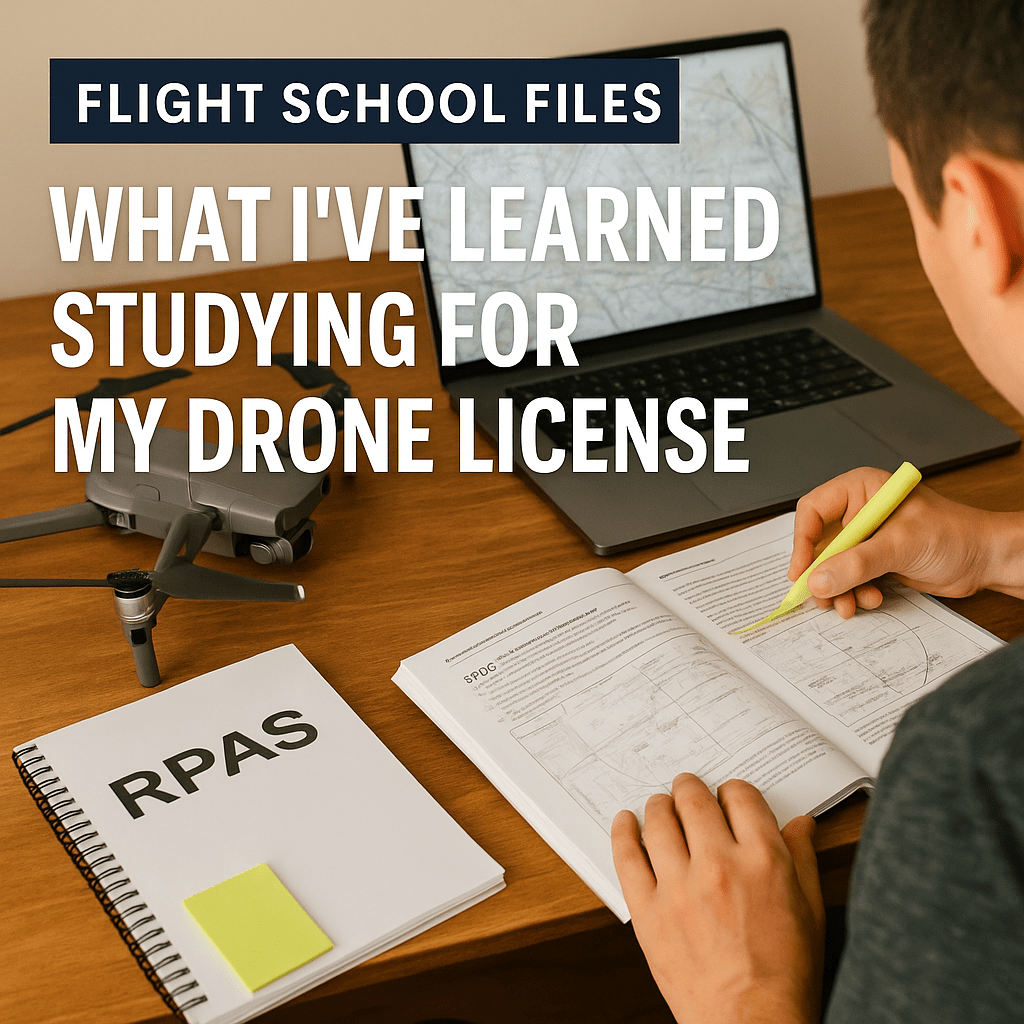
So here’s what I’ve learned (and am still learning!) while studying for my Advanced RPAS Certificate in Canada.
📘 Learn the Lingo: Licensing Terms That Stuck
Learning to fly legally in Canada means learning a whole new language. These terms are foundational — and not just for the test.
- SFOC (Special Flight Operations Certificate) – You’ll need this for beyond-line-of-sight flights or restricted airspace work. Learn it now; use it often.
- VLOS (Visual Line of Sight) – Don’t guess. Know how to maintain it and when it’s required.
- NOTAMs (Notices to Airmen) – Critical for situational awareness. You’re responsible for checking them before every flight.
- TP15263 – Canada’s drone operations bible. Get comfy with this document — it comes up often.
- Controlled vs. Uncontrolled Airspace – Know how to identify, plan for, and request access. This concept isn’t optional.
🛠️ Tips & Tricks: From Study Mode to Sky Mode
Studying for your drone license isn’t just about passing a test—it’s about developing the mindset and skills of a professional pilot. That’s why I created the Sky Commander Academy Podcast: to help aspiring pilots bridge the gap between theoretical knowledge and real-world application.
Here are some strategies that have been instrumental in my preparation:
🎧 Combine Official Study Materials with Real-World Insights
Start with Transport Canada’s Knowledge Requirements to understand the foundational concepts. Then, supplement your learning with episodes from the Sky Commander Academy Podcast, where we discuss practical scenarios and insights that bring the regulations to life.
🎙️ Suggested Listen: Episode 12 – Decode the Sky: How to Read Aviation Weather Like a Pro (Before You Crash or Get Fined)
🗂️ Utilize Flashcards for Key Concepts
Create flashcards for essential terms, altitude limits, airspace classifications, and emergency procedures. Regular review helps reinforce your memory and ensures you’re prepared for both the exam and real-world operations.
🧠 Develop Situational Awareness
The exam includes scenario-based questions that test your decision-making skills. Practice thinking through various flight situations to enhance your ability to respond effectively during actual missions.
🗺️ Familiarize Yourself with VFR Maps
Understanding Visual Flight Rules (VFR) maps is crucial for airspace awareness. Use digital tools like NAV Drone or ForeFlight to practice interpreting these maps, which will aid in both the exam and flight planning.
✈️ Conduct Mental Simulations
Visualize different flight scenarios, such as equipment failures or unexpected obstacles. Mentally rehearsing your responses to these situations can improve your readiness and confidence during actual flights.
✈️ The Big Idea: Respect the Process
Studying for this license isn’t just a formality. It’s a mindset shift — from flying casually to operating professionally.
Every regulation exists because something once went wrong. As pilots, we’re entrusted with the sky, and that means knowing the rules, respecting the airspace, and always being ready.
If you’re going through this process right now, keep going. It’s worth it — and you’re not alone. We’re flying this route together.
📰 Related Resources
- 🎙️ Episode 11 – Flying Into Trouble? What Every Drone Pilot MUST Know About Weather Before Takeoff
- 🎙️ Episode 7 – Drone Emergencies EXPLAINED: What Every Pilot Must Know Before Losing Control!
- 🛸 5 Spring Hazards Drone Pilots Should Watch For
📢 Call to Action
🎓 Are you studying for your drone license too?
Drop a comment or tag someone on the same journey — let’s support each other in the climb.
 Sky Commander – Drone Inspections & Aerial Intelligence
Leave a comment