
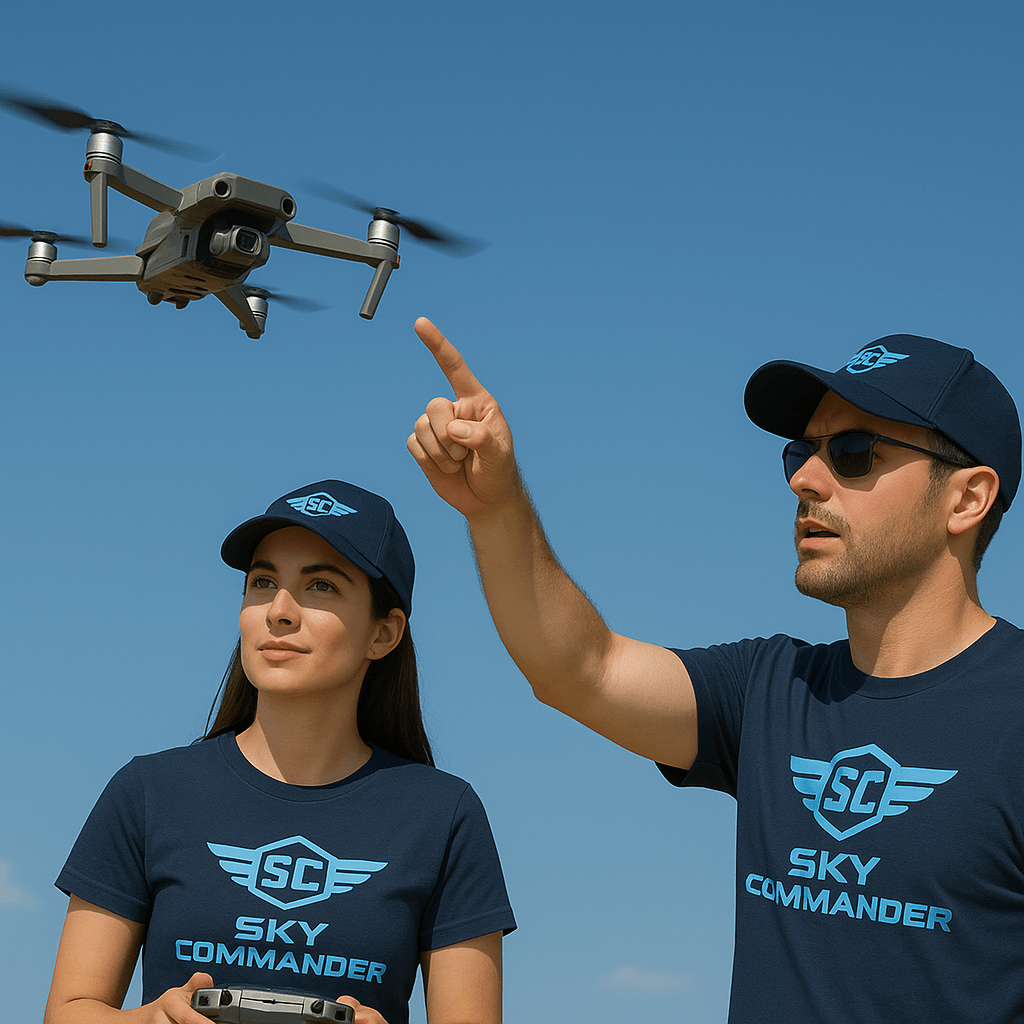
In the world of drone operations, there’s no such thing as flying solo — even when it looks like a one-person job. That’s where your Visual Observer (VO) comes in. Think of them as your wingman: watching your back, spotting hazards, and keeping your flight safe and compliant. This week on Wingman Wednesday, we’re diving into the critical communication link between the drone pilot and the VO, and how to build rock-solid teamwork in the field.
Why Use a Visual Observer?
Under Canadian regulations (CARs 901.20), a VO is required when the pilot cannot maintain visual line-of-sight (VLOS) — such as during FPV (first-person view) operations or in visually complex environments. But even when it’s not required, having a VO can significantly boost safety and situational awareness.
Basic Responsibilities of a Visual Observer
A trained VO should:
- Maintain unaided visual contact with the drone at all times.
- Identify hazards — both stationary and dynamic.
- Communicate clearly and immediately with the pilot.
- Remain focused and avoid multitasking or distractions.
Hazards to Watch For: Two Categories
We can break down obstacles into two main types:
1. Landlocked Hazards (Static)
These are fixed objects that don’t move but can easily be overlooked during flight:
- Trees and buildings
- Powerlines
- Streetlights and traffic signals
- Cell towers, antennas, and poles
2. Free-Roaming Hazards (Dynamic)
These are mobile and often unpredictable:
- Birds, especially flocks or raptors
- Kites or drones flown by others
- Balls from nearby sports fields
- Manned aircraft or helicopters in shared airspace
Best Practices for VO Communication
Before takeoff, establish a pre-flight communication protocol between the pilot and the VO. Here are some key elements to include:
Shared Directional Awareness
Make sure the VO understands the orientation of the flight path. The VO should:
- Align their view with the pilot’s direction of flight.
- Use relative callouts (e.g., “left” or “right” based on the drone’s current direction).
- When necessary, switch to absolute directions like “north” or “south” for clarity.
Example Callout:
“Bird approaching fast from your 3 o’clock – low and closing in.”
or
“Powerline dead ahead – 20 meters out, 5 meters above.”
Alert Priority Phrases
Set up a simple alert scale during your pre-flight brief:
- “Heads up” – non-critical, just awareness
- “Caution” – approaching hazard, prepare to adjust
- “Break!” – critical threat, take immediate evasive action
Standard Terminology
Stick to short, direct, and standardized terms:
- “Climb” / “Descend”
- “Left” / “Right”
- “Hold” / “Clear”
- “Obstacle – tree, west, 30 meters”
Pre-Flight Briefing Checklist for Pilot & VO
Before any mission, cover the following:
- Roles & responsibilities – who is doing what
- Flight path overview – expected directions, altitudes, and known hazards
- Callout protocol – what language to use, how to report hazards
- Emergency plan – if the drone is lost, what’s the protocol?
Final Thoughts
Flying a drone is a lot like flying a fighter jet — you need someone watching your six. A good VO is more than an extra set of eyes. They’re your second brain, your early warning system, and your in-the-field teammate. On Wingman Wednesday, we salute the folks on the ground who keep us safe in the sky.
 Sky Commander – Drone Inspections & Aerial Intelligence
Leave a comment