
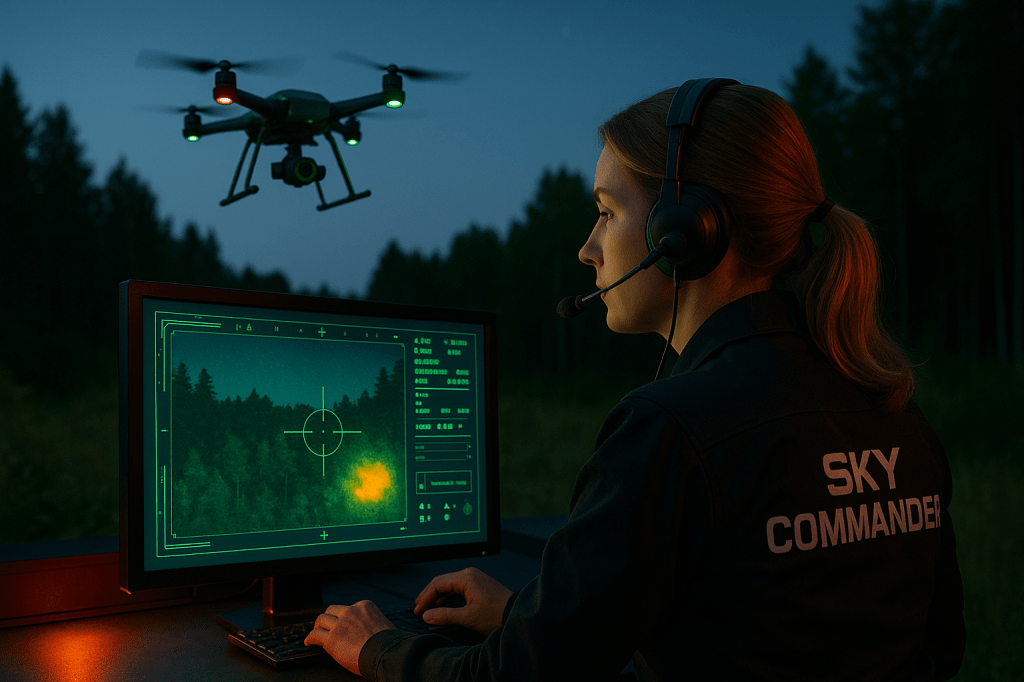
Ever wondered why some drone crews excel during night operations while others struggle? The secret might not lie in the pilot or visual observer—but in your Payload Operator (PO).
When the sun sets, the PO role transforms from important to critical. Here’s how to master your payload ops after dark—and why it matters more than ever.
💡 Lighting and Visibility: Navigating the Night
Night flying brings unique challenges, especially around visibility. Your PO is the “eyes behind the eyes,” managing lighting systems and camera payloads. Proper use of infrared (IR) strobes, floodlights, and NVG-compatible lights is essential.
A skilled PO will balance lighting effectively, providing maximum visibility without overwhelming sensitive night vision or thermal cameras.
Tip: Always ensure your PO pre-checks sensor compatibility with onboard lighting. This can save your mission from costly sensor flare-outs or blind spots.
🔥 Thermal Imaging vs. Night Vision: Know Your Gear!
Do you know when thermal imaging beats night vision goggles (NVGs)? Your PO does—or at least they should!
- Thermal cameras detect heat signatures, making them ideal for spotting equipment malfunctions, wildlife, or lost individuals in pitch darkness.
- NVGs amplify available light, offering enhanced depth perception in low-light environments.
Real-Life Scenario: A PO spotted a hidden heat signature indicating a power transformer overheating—saving a utility thousands of dollars and a potential outage.
📡 Communication Mastery: A Nighttime Imperative
At night, clear communication can be life-saving. The PO must provide timely, concise alerts about payload status, visibility issues, and potential hazards.
Nighttime Communication Essentials:
- ✅ Regular sensor and payload status updates
- ✅ Immediate alerts for unexpected visuals or reflections
- ✅ Quick coordination checks between PO, VO, and pilot
A predefined nighttime comm protocol ensures nothing critical gets missed.
🚧 Navigating Nighttime Risks: What Every PO Must Know
Night operations increase risks exponentially—terrain, wildlife, weather visibility reductions, and human error all play a bigger role.
The PO must stay vigilant, conducting continuous sensor sweeps and real-time analysis to avoid:
- Sensor blind spots from improper lighting
- Missed hazards due to fatigue or tunnel vision
- Misinterpretation of thermal images
📋 Night Flight SOP: Your Payload Operator’s Best Friend
A clear Standard Operating Procedure (SOP) tailored specifically to night payload operations is non-negotiable. It should include:
- Sensor pre-checks
- Lighting system configuration
- Communication checkpoints
- Emergency and contingency procedures
Pro Tip: Keep this SOP handy and conduct regular scenario-based training for maximum effectiveness.
🌟 Real Mission Impact: Why Your PO is the Crew’s Secret Weapon
During a recent wildfire monitoring mission, the payload operator detected a previously unseen hotspot hidden by dense vegetation. This early detection allowed ground crews to respond swiftly—potentially saving lives, property, and thousands of hectares of forest.
🌙 From Dusk to Dawn: Your Night Flight Success Checklist
✅ Confirm sensor & lighting compatibility
✅ Equip thermal imaging and NVGs properly
✅ Establish nighttime comm protocols
✅ Conduct rigorous sensor and visibility checks
✅ Implement and train on night-specific SOPs
Ready to own the night? Your Payload Operator is your frontline ally. Train them right—and let them light the way. 🛸🌌
 Sky Commander – Drone Inspections & Aerial Intelligence
Leave a comment