
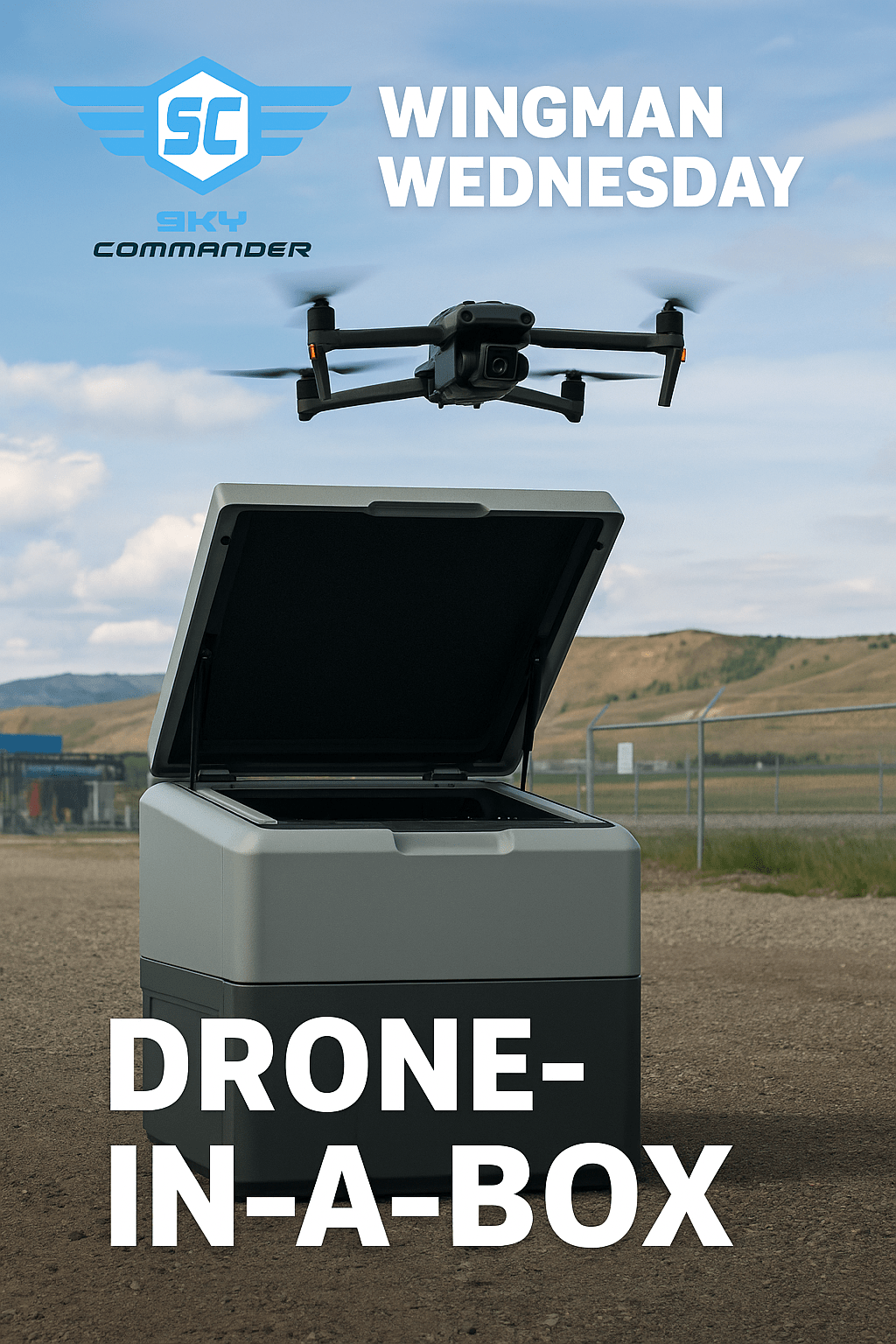
A Drone-in-a-Box (DIB) is a weather-hardened hangar + autonomous drone + cloud control that can launch, fly, land, recharge, and stand by for the next mission—without a pilot on site. It’s ideal for remote industrial assets, routine inspections, and rapid response. Today we’ll break down what DIB really takes (technology, regulations, ops playbook, ROI), how to avoid the common gotchas, and how to run a 30-day proof-of-concept that actually proves something.
What exactly is “Drone-in-a-Box”?
A DIB system combines three things:
- Dock/Hangar: Weather-sealed station that protects, monitors, and recharges the drone. Modern docks include environmental sensors (wind, temperature, rain), internal/external cameras, and backup power. (Example: DJI Dock 2 lists IP55, integrated sensors, and >5-hour backup battery for safe standby. DJI)
- Autonomous Drone: Takeoff/landing precision, robust navigation (often with RTK), and mission automation. (DJI’s Matrice 3D/3TD for Dock 2; Skydio X10 uses a visual fiducial system for pinpoint landings. DJI+1)
- Cloud & Comms: Scheduling, telemetry, live video, health monitoring, and remote control via enterprise software and APIs. (DJI FlightHub 2 / Cloud API; Skydio Dock supports Starlink/5G via Skydio Connect Fusion. DJI+1)
Why operators care: consistent repeatability (daily/weekly patrols), faster event detection, fewer truck rolls, improved safety in hazardous sites, and audit-ready logs.
Where DIB shines (and why it’s catching fire)
High-value, high-repetition missions:
- Utilities & energy: line patrols, substation sweeps, right-of-way vegetation, leak/heat signatures, flare stack checks.
- Mining & industrial plants: perimeter security, stockpile surveying, equipment hot-spot checks, blast area verification.
- Pipelines & rail: linear inspections after storms or alerts.
- Public safety & security: incident verification before sending people in.
- Agriculture & environmental: crop stress, wildlife monitoring, wetland encroachment.
Vendors are leaning in hard: DJI’s Dock 2 shrank weight/size by ~68–75% vs. the first-gen dock while extending a 10 km effective radius; Skydio’s X10 Dock pairs autonomy with hybrid point-to-point/5G/Starlink comms for remote sites; Percepto and American Robotics continue to expand BVLOS approvals that enable fully remote ops in the U.S. (Canadian readers: see the next section on our rules). Ondas Holdings Inc.+4DRONELIFE+4DJI+4
Canada 2025: what the new rules mean for DIB
Big picture: Canada’s drone rules are changing on November 4, 2025. Transport Canada has introduced Level 1 Complex Operations and a pathway for lower-risk BVLOS, with new knowledge requirements and training. Pilot licensing and registration are already transitioning, but you must follow current operating rules until Nov 4. For most true DIB use (routine remote inspections), you should still plan on an SFOC-RPAS unless your operation falls into clearly allowed scenarios. Transport Canada+3Transport Canada+3Transport Canada+3
What to do now (Canada):
- Map your use-case against current Basic/Advanced limits; if BVLOS or ops outside standard rules are required, plan your SFOC-RPAS package early. Transport Canada
- Track NAV CANADA’s NAV Drone updates rolling through 2025 that expand RPAS support and streamline authorizations. navcanada.ca
- Skill up for Level 1 Complex: study the new TP 15530 knowledge requirements and set your Flight Review prep accordingly. Transport Canada
Wingman note: If you’re eyeing a DIB program for 2026 scale-out, 2025 is the year to nail your training, airspace procedures, and SFOC templates.
Vendor snapshot (what’s out there now)
- DJI Dock 2 + Matrice 3D/3TD
Compact, lighter, 10 km effective radius; IP55 dock, IP54 aircraft; -25° to 45 °C dock operating temps; integrated environmental monitoring; FlightHub 2 & Cloud API support. Ideal for repeatable missions with tight integration. DJI - Skydio Dock for X10
Precision fiducial landings; Starlink + 5G hybrid comms (Connect Fusion) so truly remote sites are feasible. Strong autonomy heritage & U.S. enterprise footprint. skydio.com+1 - Percepto (DIB platform)
FAA-approved framework for scalable BVLOS in the U.S., focused on industrial inspections without on-site personnel; a bellwether for where regulations are going. Percepto - American Robotics (Ondas)
Ongoing FAA BVLOS waivers (including over people/moving vehicles) managed from a remote operations center—signals maturing remote-ops capability. Ondas Holdings Inc.+1 - Heisha D80 (open, DJI-compatible docks)
Modular, vendor-agnostic style docking with versions supporting multiple airframes; interesting for custom fleets and cost-sensitive deployments. flytbase.com+1 - Azur Drones Skeyetech E2
European DIB leader focused on 24/7 security/industrial monitoring with BVLOS-oriented ops and tight VMS/security integrations. azurdrones.com+1
Prices vary widely by configuration and services. As a datapoint on “mobile DIB,” DJI showcased Dock 3bundles earlier this year in the low-$20k USD range (hardware only), but real-world deployments add installation, networking, software, and integration costs. Use as a directional anchor only. The Verge
Alberta-proof: environmental & site considerations
Weather & climate:
- Temperature: Verify your dock/drone envelope against local extremes. DJI Dock 2 is rated to -25° to 45 °C, with standby limits below -20 °C; plan pre-heating windows in deep winter. DJI
- Ingress protection: IP55 (dock) ≠ waterproof. Snow loading, driven rain, and dust require siting, shielding, and regular cleaning. DJI
- Wind: Know your takeoff/landing limits (e.g., Dock 2 lists 8 m/s allowable landing wind; operational wind resistance differs). Build wind holds into your scheduler. DJI
Infrastructure:
- Power & UPS: Stable AC; consider surge protection and lightning protection that meets IEC/EN 61643 levels (Dock 2 gives Type 2 guidance for AC, Cat C for Ethernet). DJI
- Backhaul: Redundant internet (wired + LTE/5G; Starlink for remote). Verify firewall rules, VPN, and QoS. (Skydio highlights Starlink & 5G handoff.) skydio.com
- Pad siting: Avoid multipath (metal roofs, towers) near RTK base; ensure clear approach arcs and wildlife mitigation.
Security & compliance:
- Cyber: Lock down cloud APIs, rotate keys, and segment networks.
- Physical: Fences, cameras, tamper alerts; snow-clearance plans.
- Regulatory: Ops manuals, SFOC conditions, NOTAMs/authorizations where needed; incident/occurrence reporting workflows.
Ops playbook: how a DIB mission actually runs
- Plan & schedule: Define mission templates (route, altitude, sensors, capture cadence).
- Automated launch: System runs preflight checks, weather gating, geofence checks, and launches in a safe window.
- Flight monitoring: Remote operator watches telemetry/video while the aircraft executes.
- Precision recovery: Guided by RTK/fiducials, the drone autolands; dock closes and charges. (Skydio documents fiducial landings; DJI lists 32-minute 20→90% charge time under lab conditions.) skydio.com+1
- Data pipeline: Media/telemetry upload to cloud; analytics (thermal thresholds, change detection, 3D reconstructions) kick off automatically.
- Alerting & reporting: Exceptions push to Slack/Teams/Email; daily/weekly reports summarize findings and trends.
ROI on a napkin (make it real)
- Current state: 1 patrol = 2 h travel + 1 h on site = 3 h crew time. At $120/h fully loaded, that’s $360 per patrol (not counting fuel/vehicle wear/risk).
- Patrol cadence: 5×/week → $1,800/week, ~$93k/year for one site.
- DIB program: Even with enterprise hardware, install, and software, a well-utilized dock replacing 3–10 patrols/week typically pays back within 6–18 months, while improving detection latency and safety. (Use your own numbers; include avoided incidents and earlier fault detection.)
Pro tip: Don’t sell “flight minutes,” sell risk reduction and response time. That’s where true value lives.
30-day proof-of-concept (POC) that actually proves something
Week 0 (Prep):
- Pick one site with clear pain (distance, security risk, weather exposure).
- Define 3 outcomes: (1) response time, (2) inspection coverage, (3) exception detection accuracy.
- Draft SFOC-RPAS (if required) and NAV Drone workflows; assign PIC/VO roles and escalation tree. Transport Canada+1
Week 1:
- Install dock, commission comms (primary + failover), validate approach/landing arcs, set weather gates.
- Dry runs: 10 autoland cycles in varied winds.
Week 2:
- Run daily missions (dawn & dusk). Verify data pipeline to your CMMS or ticketing system.
- Calibrate analytics thresholds (thermal hotspots, change detection).
Week 3:
- Inject three controlled anomalies (e.g., simulated hot bearing, obstructed gate, vegetation encroachment) and measure detection + time-to-ticket.
Week 4:
- Report on KPIs: % successful sorties, avg response time, false-positive/negative rates, avoided truck rolls, cost deltas. Decide go/no-go for scale-up.
Common pitfalls (and how to dodge them)
- Connectivity lies: “Great bars” until the first storm. Use two independent ISPs or ISP + Starlink, test under load, and simulate outages. skydio.com
- Landing surprises: Snow drifts, nesting birds, loose debris. Add pad cameras, daily image checks, and a “pad clear” checklist.
- Regulatory mismatch: Assuming BVLOS is “covered.” In Canada, assume SFOC unless you are squarely within an allowed lower-risk profile; keep ops manuals current through November changes. Transport Canada+1
- Data graveyard: Flights run, footage vanishes. Decide where the truth lives (FlightHub/Skydio Cloud/SIEM/CMMS) and wire it before POC. DJI
- Cold-soaked hardware: Alberta winters push limits. Lean on pre-heat, weather gating, and scheduled “maintenance cycles” on cold snaps. (Dock 2 details charging/AC behavior and temperature limits—study them.) DJI
Your DIB readiness checklist (print this)
- Regulatory: Category mapping → SFOC plan → Level 1 Complex training → NAV Drone workflows. Transport Canada+2Transport Canada+2
- Site & safety: Pad siting, approach arcs, wildlife plan, snow/wind ops, lightning/surge protection. DJI
- Comms: Primary + backup internet, VPN, port rules, bandwidth tests, camera access. skydio.com
- Ops: Mission templates, weather gates, SOPs, escalation, maintenance cycles.
- Data: Storage location, retention policy, analytics thresholds, ticket integration.
- People: PIC/VO upskilling, Flight Review refreshers, emergency drills.
Want examples to benchmark?
- DJI Dock 2: Specs show 10 km operating radius, IP55 dock, -25° to 45 °C dock temps, 32-minute 20→90% charge (lab conditions). DJI
- Skydio Dock for X10: Fiducial landing, Starlink/5G hybrid comms for remote sites. skydio.com+1
- Percepto (U.S.): BVLOS approvals enabling zero on-site personnel for industrial inspections. Percepto
- American Robotics (U.S.): New 2025 FAA BVLOS waiver including ops over people & moving vehicles, managed from a Remote Ops Center. Ondas Holdings Inc.+1
What to read/watch next (Canada-focused)
- 2025 Transport Canada changes (what’s coming Nov 4 and what it means now). Transport Canada+1
- Get permission for special operations (SFOC-RPAS) — start your package early for DIB. Transport Canada
- NAV Drone 2025 updates — how authorizations are evolving. navcanada.ca
Final approach
Drone-in-a-Box isn’t sci-fi anymore—it’s standard kit for high-value sites. If you’re spending real money on travel, rolling trucks for routine patrols, or delaying eyes-on after alerts, a DIB can be your tireless wingman: faster detection, fewer risks, better data.
Where would you deploy a DIB first—and what would success look like? Tell us in the comments, or reach out and we’ll help you design a POC that’s Alberta-proof.
 Sky Commander – Drone Inspections & Aerial Intelligence
Leave a comment