
Summary (TL;DR): coming out of a long weekend, small gaps become big risks. reset your team with a gratitude mindset and a hard-edged safety tune-up: refresh crew roles, batteries, firmware, calibrations, airspace, human factors, and emergency drills. then prove it in the field with micro-checks and short practice missions you can do in 20 minutes.
Hero image suggestion (alt-text):
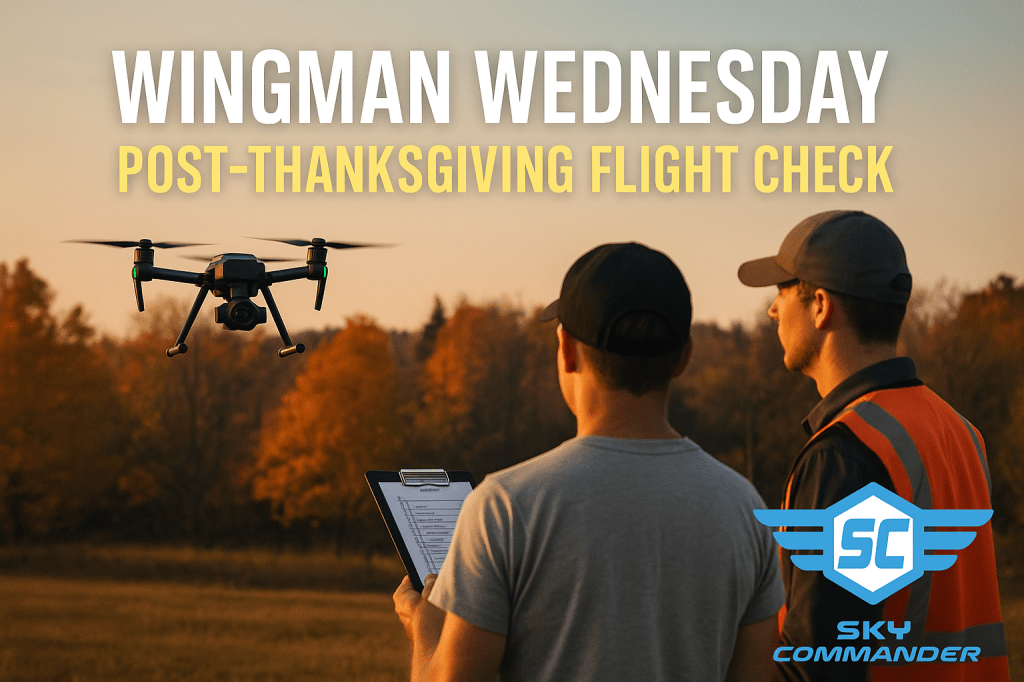
alt: “Sky Commander field team performing a sunrise pre-flight beside a service truck; Mavic-class drone on landing pad; fall colours; checklists clipped to clipboard.”
caption: Post-holiday, pre-flight: gratitude + discipline = safer skies.
Meta description (≤160 chars):
Post-Thanksgiving Wingman Wednesday: practical safety reset for drone crews—checklists, drills, battery and firmware audits, human-factors cues, and debrief tools.
Categories/Tags: Wingman Wednesday, Safety, SOP, Batteries, Firmware, Human Factors, Risk, Transport Canada, RPAS, Powerline Inspection, Field Ops
Why “gratitude + safety” works (and why today)
Gratitude focuses attention. Safety demands attention. Put together, you get calmer execution, clearer comms, and fewer misses—exactly what we need after a long weekend when rust, routines, and conditions may have shifted (shorter daylight, cooler temps, leaf fall, wildlife movement, holiday traffic near parks and trails).
Crew opener (use this verbatim in your tailboard):
“Two quick prompts: something we’re grateful for today, and the single biggest risk to this mission. Call it out.”
1) Ten-Point Post-Holiday Safety Reset (fast but thorough)
1. Weather & environment refresh
- Wind/temps: colder air = denser air = more thrust but faster battery sag.
- Sun angle: earlier dusk → shadows and glare; plan earlier retrieval.
- Leaf-off/leaf-on: new line-of-sight but more branch tip hazards.
- Wildlife: migrating birds form flocks at altitude; add a bird-strike abort plan.
2. Airspace & advisories
- Re-pull NAV CANADA NOTAMs and DAH/Canada Flight Supplement notes for the week; temporary advisories pop up over long weekends (events, VIP, wildfire).
- Confirm RPAS flight authorization if applicable (Class C/D). Re-validate your site survey.
3. Firmware & app sanity check
- If anything auto-updated over the weekend, test-hover 60–90 seconds in a sterile area.
- Re-calibrate IMU/compass/gimbal if logs show drift or if you transported gear far from last site.
4. Battery health audit (the “3×3 test”)
- Before: voltages within 0.03 V between cells; IR within historical norms.
- During: watch live voltage sag under climb; set conservative RTH.
- After: log mAh returned vs. consumed; flag >7–10% anomaly once, retire if repeated.
5. Payload & optics
- Clean lens/filters. Check for condensation in colder mornings.
- Validate payload settings (frame rate, resolution, thermal palettes) match mission deliverables.
6. SD cards & data integrity
- Format in-aircraft; verify write speed; carry a verified spare.
- Spot-test record for 10 s and review.
7. Controls & geofencing
- Confirm stick mode, expo, flight mode limits, and any geofence unlocks (carry proof of authorization).
- Check RTH altitude against new vertical obstacles (cranes, fall harvest equipment).
8. Crew roles & brief
- PIC, VO, payload—each states one emergency they own (see section 4).
- Confirm handoff phrase (“You have control / I have control”).
9. Site changes
- New vehicles, public events, seasonal infrastructure (temporary lighting poles, banners).
- Re-draw public buffer; mark cone and signage if near path/trail.
10. Mental state / fatigue
- Ask privately: S.A.F.E. (Sleep, Alcohol/meds, Food/hydration, Emotions).
- If two or more are off, downgrade the mission or reassign PIC.
2) Sky Commander Pocket Checklists (print or paste into your SOP)
A. 90-Second Cold-Start (field)
- Power on RC → AC → app connects; satellites healthy.
- Battery check (voltage, cycles, temp).
- RTH altitude set; home point confirmed.
- Compass/IMU status green; gimbal horizon OK.
- Payload settings match mission; SD OK.
- Airspace/NOTAM last-minute confirm; launch area sterile.
- Verbal go/no-go with crew. “You clear?” → “Clear.”
B. Pre-takeoff Abort Triggers
- IMU warning, compass interference, GPS degradation.
- Unstable hover >30 cm drift in 10 s.
- Cell delta >0.05 V or rapid sag on throttle blips.
- Unexpected geofence behaviour.
C. Low-Altitude Powerline Recon (≤30 m AGL)
- Into-wind approach; stabilize; ascend to working height.
- Lateral offset set (no direct over-span hover on first pass).
- Keep emergency climb path clear; rehearse climb on sticks.
- Maintain VO line-of-sight on aircraft and wires.
3) Batteries: the post-holiday weak link
What changes after a break? packs cool, self-discharge, and cell drift widens.
Quick health rubric:
- Green: cell delta ≤0.02 V after 1 min hover; temp ≥15°C before launch.
- Amber: delta 0.03–0.05 V or temp 5–15°C → limit to 60% mission load.
- Red: delta >0.05 V, puffing, odd IR → retire & label “DO NOT FLY.”
Cold-weather technique: pre-warm packs in insulated pouch; launch at ≥15°C; do a gentle 30–60 s hover before aggressive climbs.
Data to log (3 fields): cycles | lowest in-flight voltage | landing %SOC. Patterns beat hunches.
4) Emergency mini-playbooks (assign owners)
A. Lost-link / flyaway (PIC owner)
- Count to 3; no regain → RTH confirm; VO scans sky; payload operator looks at map trail.
- If RTH unsafe (tall obstacles), cancel RTH → hover → step to clear sky → manual climb then lateral home.
B. Bird conflict (VO owner)
- VO calls “Birds high right / low left” with clock code.
- PIC: immediate gentle descent + lateral slide; avoid climbs into birds.
- If persistent, land; adjust launch point away from food/water sources.
C. Battery thermal event (payload/ground crew)
- Land if airborne; isolate pack in sand/metal bin; no water on Li-ion.
- Ventilate vehicle; report and retire pack.
D. Public incursion (VO)
- VO steps forward, hand up, friendly: “Hi there—active flight zone for safety, we’ll be done shortly. Please stand behind the cone.”
- PIC holds position or climbs to sterile hover.
5) 20-Minute Skill Drills (confidence builders)
Drill 1: Hover box
- Draw a 2×2 m square with cones. Hold position at 2 m, each corner for 10 s. Objective: prove control smoothness post-break.
Drill 2: Approach & offset
- Practice lining up to an imaginary span, stopping 5 m short, sliding laterally 3 m, then backing away. Objective:muscle memory for wire-adjacent ops.
Drill 3: Camera discipline
- 60 s: expose for dark background, then bright sky; practice quick, non-jerky gimbal moves. Objective: data quality on first try.
6) Seasonal hazards checklist (Fall → Winter)
- Glare: low sun; use brimmed hat for VO; keep aircraft sun-side when possible.
- Icing: wet snow/fog + sub-zero = no-go.
- Ground temps: cold asphalt → brittle props; inspect edges before/after.
- Vehicles & farm equipment: increased rural traffic; plan launch sites off haul routes.
- Wildfire TFR remnants: verify NOTAMs even if season is “over.”
7) Human factors: make the invisible visible
Use PAVE (Pilot, Aircraft, enVironment, External pressures).
- Pilot: SAFE check (sleep/meds/food/emotions).
- Aircraft: batteries, firmware, maintenance status.
- Environment: wind, lighting, obstacles, birds, people.
- External: client schedule, “just one more shot” pressure—call it out early.
Two questions that save missions:
- “What would make us abort today?”
- “If we had to explain this flight to Transport Canada tomorrow, are we proud of our prep?”
8) Debrief like a pro (5 minutes, tops)
Template (say it out loud; then jot 3 bullets):
- What worked:
- What bit us (or almost did):
- What we change next time:
- Battery notes: cycles / low-V / landing SOC for each pack.
- Media integrity: sample clip OK, hashes verified if required.
Culture tip: reward “near-miss honesty.” The lesson you hide today becomes tomorrow’s incident.
9) Documentation quick-wins (Transport Canada-friendly)
- Site survey (map, obstacles, public buffer).
- Pilot currency (recency, training).
- Aircraft maintenance & battery logs.
- Flight log (date/time, duration, location, purpose, anomalies).
- Authorizations/unlocks kept on device and printed.
If you can’t produce it at the truck tailgate in 60 seconds, it’s not “operational.”
10) Gratitude that moves the needle
- People: thank your VO. They catch what you can’t.
- Public: a friendly wave and a short explanation (“infrastructure safety work”) earns trust.
- Process: honour your checklists—the quiet heroes that keep flights boring (and successful).
Wingman mantra for the week: “Calm is contagious. So is gratitude.”
 Sky Commander – Drone Inspections & Aerial Intelligence
Leave a comment