
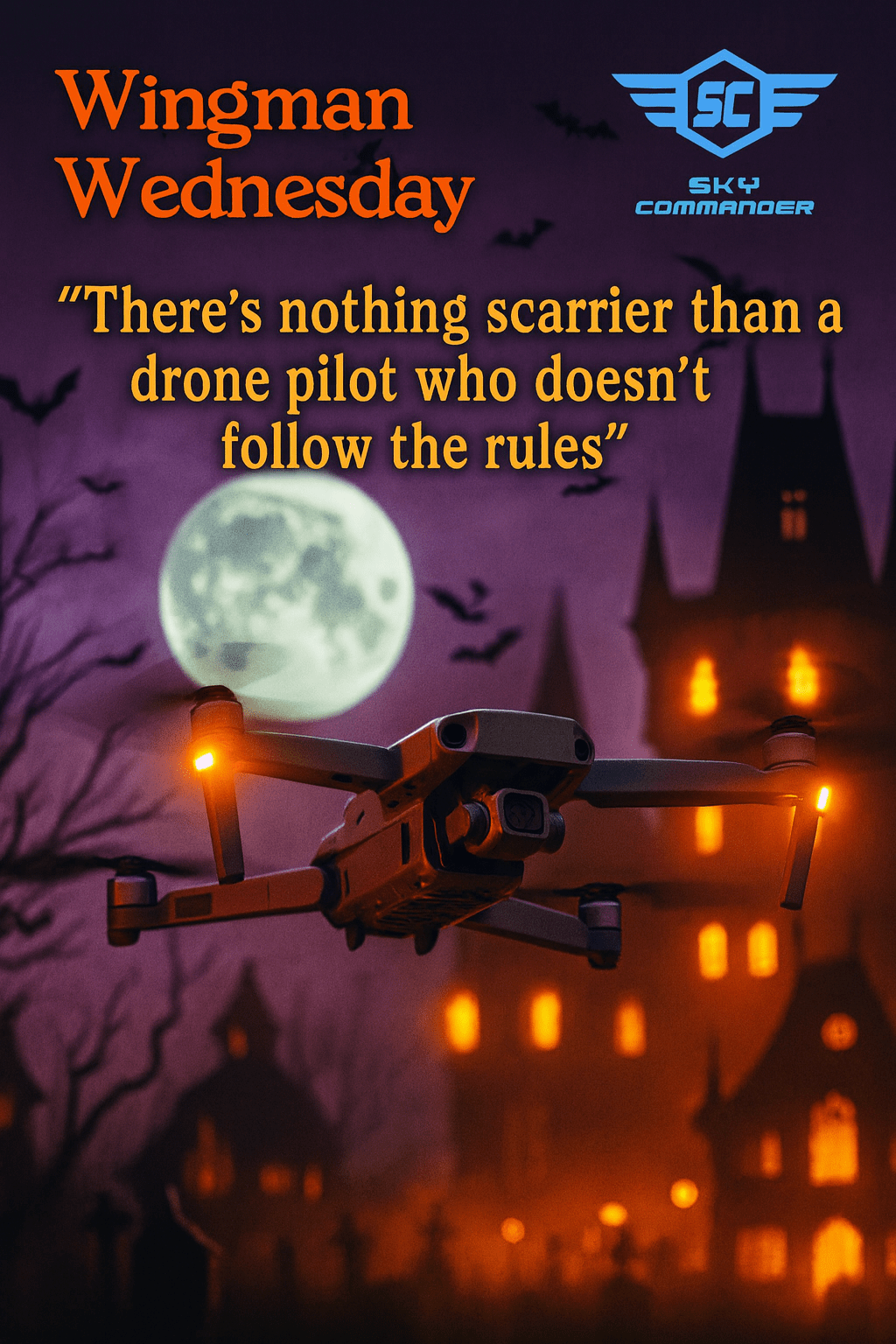
Gala Week Edition — Fly safe. Avoid the fright-suite.
It’s that time of year when ghosts, ghouls and goblins get all the attention. But for the smart RPAS pilot? The real horror show happens when your mission ends up on the “what-not-to-do” reel.
Because let’s face it: there is nothing scarier than a drone pilot who doesn’t follow the rules. And when it’s Gala Week, with parties, night flights, fancy venues and extra spectators… the stakes go up.
So for this week’s Wingman Wednesday, we’re embracing the Halloween vibe — we’ve got costumes, gala lights, maybe a haunted house in the background — but the message is serious: if you skip the checklist, ignore the regs, or fly on autopilot (literally or figuratively) you’re inviting trouble. Let’s turn the spotlight on how things can go south quickly — and how you can keep your mission safe, professional and ready for the big league.
🦇 The Costumes Don’t Fool Anyone – What you must wear
As you suit up for the gala, don’t forget the best costume of all: Compliance + Safety.
Here’s what every pilot should have:
- Your pilot certificate/cards up-to-date (basic or advanced)
- NAV Drone authorization (if required) and any CRA/TC forms completed
- Pre-flight checklist (battery, firmware, environment, airspace)
- Risk assessment that matches the mission — especially if the venue is busy or night-time
- Clear communication: who’s on the crew, who’s VO (if needed), who’s support
- Emergency plan: lost link? fly-away? spectators in the path?
Wearing a tux? Great. Flying without your risk assessment? That’s the real horror show.
👻 Scary Scenarios You Want to Avoid
Let’s walk through five “spooky” things that can go wrong — and how to avoid them.
1. The Silent Spectator Incident
Picture this: you’re flying above a gala tent; people milling below; music, lights, distraction. You see the drone drifting. You hear a crack-pop. You’ve clipped a string of bunting or a roof overhang you didn’t notice.
What went wrong: Poor situational awareness + inadequate pre-flight scan of the environment.
Avoid it by:
- Doing a visual sweep of all hazards around (powerlines, guy-wires, light fixtures, awnings) before you fly.
- Considering spectators: keep a safe lateral separation and altitude margin.
- Using a visual observer (VO) especially if flying near people / structures.
2. The Night-Flight Zombie
It’s dark. The drone lights are on. You think you’re safe. But your firmware is outdated, GPS is weak, and the battery isn’t healthy. Suddenly you lose link. The drone drifts. A fancy chandelier shudders.
What went wrong: Risk assessment neglected night conditions + equipment readiness.
Avoid it by:
- Checking firmware and system health ahead of time (especially less-common flight times).
- Ensuring your drone has good GPS lock and battery margin for unexpected delays.
- Adjusting your flight plan for night operations: slower manoeuvres, increased separation, extra margin for error.
3. The Airspace Masked Monster
You got NAV Drone approval. All green lights. You hit the sky. But the Gala is in a zone where supplemental restrictions apply (helicopter pad nearby, temporary no-fly for film crews, etc.). Suddenly RC lighting picks up a chopper in your area. Your flight is suspended — and you’re now in trouble.
What went wrong: Over-reliance on one clearance source; didn’t check local temporary restrictions or vertical limits.
Avoid it by:
- Using NAV Drone approval plus verifying with other sources: NOTAMs, Canada Flight Supplement (CFS), Designated Airspace Handbook (DAH).
- Checking for temporary restrictions (film set? concert venue? helicopter landing zone?).
- Keeping dialogue open: local aerodrome, venue operator, security team — alert them to your presence and plan.
4. The Costume-Change Crash
Your gala flight is photo/video centrepiece. You switch from aerial to ground shots, change your payload, adjust the camera. In the hustle, you forget you moved the payload forward, changed the CG, now the drone behaves badly mid-hover and clips a tree.
What went wrong: Changing configuration mid-mission without re-assessing.
Avoid it by:
- Treating any configuration change as a new mission leg: re-run the appropriate sections of your checklist.
- Staying conservative: if you change payload/CG/mission profile, reduce speed/altitude until you’re confident.
- Communicating with your team: everyone knows the change, what new risk it brings, and how you adapted.
5. The After-Party Phantom
Mission is done. You’ve captured the gala’s dramatic overhead shot. The guests applaud. You pack up. But you forget that you left the drone sitting in the back of the vehicle in full sun, hot battery warming. Two hours later: thermal runaway. Fire. Panic.
What went wrong: Post-flight complacency + temperature/risk factor ignored.
Avoid it by:
- Including a post-flight checklist: secure the drone, remove battery if necessary, monitor for heat build-up.
- Removing batteries from vehicle when outside temperature or sunlight can heat them unchecked.
- Having fire suppression or safe storage plan for spent batteries (especially with Li-Po risk).
🎯 Five Quick-Hit Gala-Week Safety Tips
- Brief early, fly early — If the gala has pre-event lighting or rigging, do a recon prior to flight day.
- Spectator buffer zone — Maintain extra lateral/vertical distance when over or near live crowd activity.
- Use visual aids — LED lights, flags, cones: make yourself visible to ground crew and spectators.
- Check your shadows — Late-day/early night flights: your shadows change, things you thought were clear may hide hazards.
- Have a “Plan B” flight path — If weather shifts, lighting changes, or crowd moves, be ready to re-route or abort.
🏆 Why This Matters — Not Just for Show
The gala may look glamorous. Your drone presence may add wow-factor. But the regulatory, financial and reputational risks are real:
- One incident can trigger investigation by Transport Canada, potential certificate suspension or fines.
- Your client’s confidence and future referrals hang on how seamlessly you executed.
- You’re flying not just your craft — you’re representing the entire drone-industry. A “bad actor” on a gala flight makes the news (and not in a good way).
✅ Your Gala Flight Pre-Mission Checklist
- Pilot certificate & documents on-hand
- Airspace check: NAV Drone + NOTAMs + CFS/DAH
- Risk assessment updated for night / crowd / structure hazards
- Visual Observer assigned (if needed) and briefed
- Equipment health: battery, firmware, compass/cal, GPS signal, payload CG
- Environmental scan: lighting, crowd movement, wind/turbulence near structures
- Launch/recovery zone secured & defined
- Post-flight plan: battery storage, data download, debrief
🎉 Wrap-Up: Fly the Gala. Avoid the Horror.
Gala Week is your chance to shine — but don’t let the glitz distract from safe, professional flying. Remember: spooky costumes are for the guests. You’re not here to scare anyone — except maybe the rules-breakers by doing everything right. 😉 Because ultimately, the scariest thing in the sky is a drone pilot who thought “It’ll be fine” instead of “I’ve got a plan.”
Stay sharp. Fly safe. Be the pilot everyone trusts.
Until next Wingman Wednesday —
See Above. Go Beyond. Get Ahead.
 Sky Commander – Drone Inspections & Aerial Intelligence
Leave a comment