
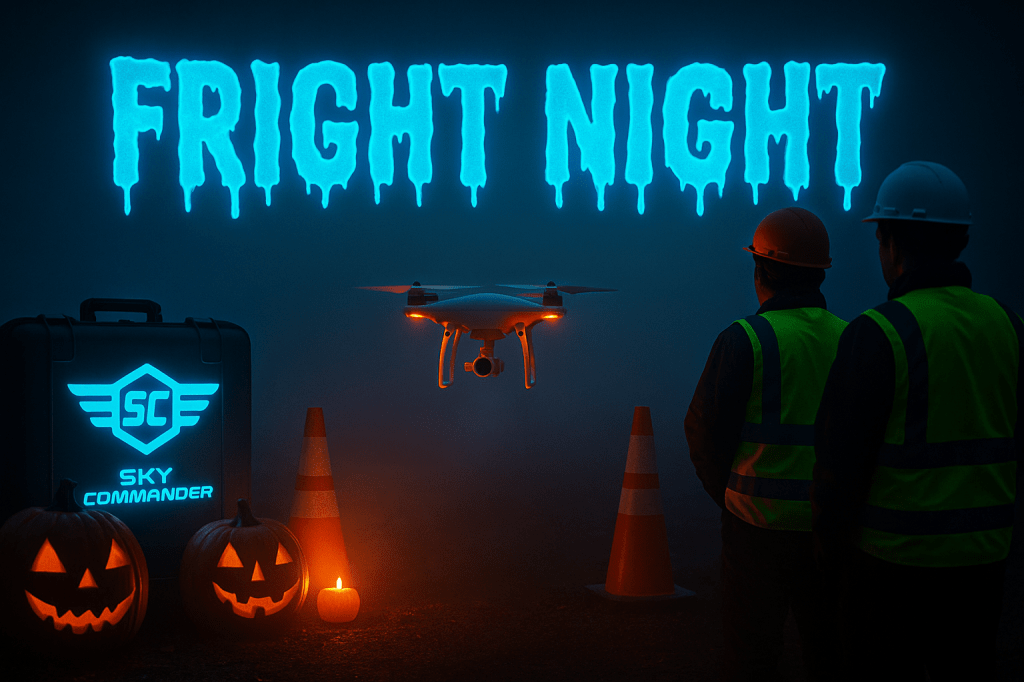
The fog rolls in, the pumpkins grin, and somewhere in the distance a strobe blinks like a lighthouse at sea. Night flying can feel spooky—but it doesn’t have to be. Done right, darkness actually becomes an advantage: cooler roofs pop on thermal, sites are quieter, and you get to practice in the lighting you’ll face on real jobs.
Why fly at night?
After sunset the world calms down. Vehicle traffic thins, distractions drop, and heat-soaked surfaces cool, giving thermal cameras that crisp contrast we love. Security sweeps, SAR exercises, utility checks—many missions are cleaner and safer when the sun is off duty. Night isn’t a bug; it’s a feature you can plan for.
A little midnight movie: “Substation Roof Hot-Spot”
It’s 21:15 after a windstorm. Our RPIC and VO arrive first to walk the site. We mark the wires and poles that are easy to miss in daylight and nearly invisible at night. The landing zone goes in the corner of the paved yard—eight to ten meters of clear space with a defined abort corridor. Cones and small LED pucks sketch a glowing box on the ground. The light is aimed low so it paints the pavement, not our eyeballs.
Before arming the props, we run the “people first” check. High-vis vests? On. Retroreflective bands? On. Headlamps in red mode to save our night vision? On. The VO clips a steady marker light to their vest and claims the wire corridor like a hawk.
The aircraft gets its own costume: anti-collision lighting bright enough to be seen from a distance but dimmed just enough that it doesn’t nuke our vision. (U.S. pilots: know your 3-statute-mile ACL rule and night-training requirement. Canadian pilots: keep the drone lit so you or your VO can always see it. Either way—VLOS rules.)
We launch. The first minute is slow and boring on purpose: short, low-contrast orbits to confirm bearings and links. Then the thermal grid—orthogonal passes at conservative speed to lock in sharp frames. The VO keeps a steady cadence: “Clear… wire left… traffic far right… you’re good.” If glare sneaks onto the screen, a vehicle turns into the lot, or the VO loses the track, we don’t debate: Abort, recover, reset.
Landing is inside the glowing box we set at the start—no drama, just choreography. Lights stay on until the props stop. Then we debrief: Did the floodlight angle work? Did anyone fight false horizons? What would we tweak for next time? Notes go into the log and any “maybe” images get flagged for a daylight confirm pass.
Make the night work for you
Think of visibility in four layers:
The crew. Dress like you want to be found in a power outage: high-vis with retroreflective tape, a steady personal marker light (not a blinding strobe), and headlamps with red mode for checklists. Keep screens dim; your pupils will thank you.
The landing zone. Give yourself a stage. Four to eight cones or LED pucks outline a 3–4 m box. A simple “UAS NIGHT OPS — DO NOT ENTER” sign at the approach path keeps curious feet out.
The aircraft. Strobes help others see you; they don’t help you see it. If the flash wrecks your night vision, reduce intensity (where allowed) and add a small orientation light that’s steady and dim.
The plan. Tighten the envelope. Night amplifies illusions, so fly shorter legs and scan deliberately. A great VO is gold—assign them the highest-risk hazard (usually wires) and let them obsess over it.
Pro tips you’ll actually use
- Don’t stare at the strobe. Glances only.
- Aim your flood at the ground, not faces. Bounce light to reveal texture and trip hazards.
- VO owns the wire. One person, one mission-critical hazard.
- Chase contrast. Right after sunset is magic for many thermal jobs; full dark is excellent for others. Test on site.
 Sky Commander – Drone Inspections & Aerial Intelligence
Leave a comment