
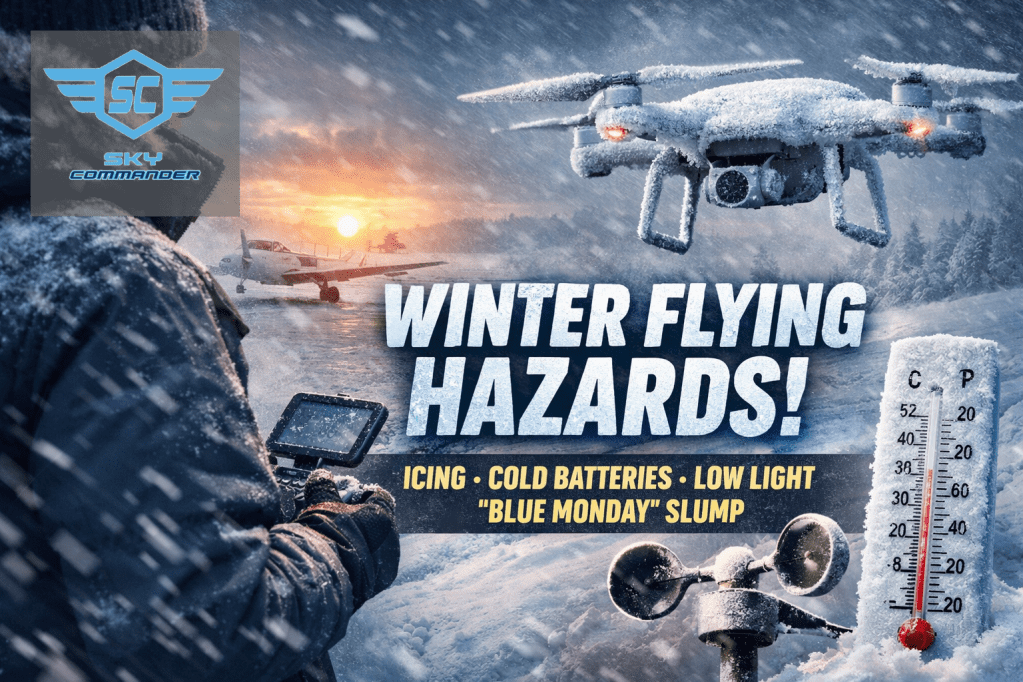
Winter doesn’t care about your schedule.
It doesn’t care that you finally have a free hour.
And it definitely doesn’t care that your batteries were “fine last week.”
This Wingman Wednesday is a winter-flying reality check: the hazards that actually bite pilots (cold, wind, moisture, daylight), how to manage them like a pro, and a human-factor focus reset coming off “Blue Monday” (the third Monday in January) — a label with no scientific basis, but one that resonates because this time of year is dark, cold, and mentally heavy for a lot of people.
See Above. Go Beyond. Get Ahead.
The Winter Threat Stack (What Changes First)
Winter risk isn’t “one big thing.” It’s a stack:
Cold → battery voltage sag + reduced performance
Wind → higher power draw + drift + pilot discomfort
Moisture/precip → icing risk + electronics/motor issues + visibility loss
Low daylight → shorter windows + rushed decisions + reduced situational awareness
If you only remember one line:
Winter doesn’t just reduce performance — it reduces your margin.
The Non-Negotiable: Icing Isn’t “Spicy Weather”
Transport Canada is blunt for a reason:
- Don’t fly with any ice or snow on the aircraft.
- Don’t fly into known/forecast icing unless you’re properly equipped for de/anti-icing and icing detection.
In winter, “a little damp air” + “just below freezing” can turn into prop/rotor icing fast. The risk isn’t theoretical — icing changes lift/drag and control authority quickly.
Wingman rule: If icing is plausible, your job isn’t to “try.” Your job is to pick a different day.
Cold Batteries: The Quiet Winter Failure Mode
Your drone can look perfect and still be one bad voltage drop away from an auto-landing you don’t want.
Sky Commander’s own battery post puts it simply: too cold = higher internal resistance and mid-flight voltage drop.
How pros manage it:
- Start fully charged.
- Pre-warm batteries before flight (DJI: if below 5°C, preheat to above ~20°C).
- Expect shorter flights and treat early low-battery warnings as real, not “annoying.” (This is a common winter trap.)
- Fly smoother (aggressive stick inputs can trigger voltage drops sooner in the cold).
Winter decision point: Plan your mission like you’ve got less battery than the app says.
Wind: Winter’s Multiplier
Wind doesn’t just push your drone around — it increases power draw and turns every hover into a fight.
What to do:
- Use a tighter flight box (keep your aircraft closer than you would in summer).
- Avoid downwind “stretch missions.” It’s easy to get out far and discover your return leg is uphill into a headwind.
- Build an abort rule before takeoff:
“If I see sustained drift at X distance/altitude, I’m landing. No debate.”
Transport Canada also calls out the pilot side: cold + wind reduces dexterity and endurance — which matters more than most people admit.
Snow, Fog, Freezing Drizzle: Moisture Is the Hidden Boss
DJI’s winter guidance is clear: avoid strong wind, rain, and snow, and avoid direct contact with snow—moisture can cause damage (landing pad recommended).
Winter best practices:
- Use a landing pad every time (snow + slush + ice chunks + motors = bad combo).
- Watch visibility like a pilot, not a photographer. Snowfall and flat light can erase depth cues.
- Post-flight condensation check: coming from cold air into a warm vehicle can create moisture where you don’t want it. Give gear time to acclimatize before sealing it up.
The Daylight Squeeze: Don’t Let the Clock Turn You Into a Risk Taker
Winter daylight is a real operational constraint — and it messes with people. CAMH notes that this time of year hits hard because daylight is limited, nights are long and cold, and fatigue/concentration issues show up for many.
What this means for flying:
- Shorten your mission scope. Do fewer objectives per flight.
- Add time buffers (setup always takes longer when it’s cold).
- Don’t “race the sunset.” Rushed pilots skip steps. Skipped steps become incident reports.
“Blue Monday” Human Factors: A Focus Reset You Can Use Any Day
Blue Monday is basically a cultural label (and CAMH notes there’s no scientific basis for one “most depressing day”).
But the winter slump effect is real enough that it can show up in your flying as:
- Risk drift (“I’ve done this a hundred times…”)
- Task fixation (tunnel vision on the shot, not the environment)
- Short temper / rushed comms
- Checklist skipping because your hands are cold and your brain wants to be done
The 30-Second “Mind on Task” Check (Do it before arming)
Ask:
- What’s my mission today — in one sentence?
- What’s the biggest winter risk right now? (wind / icing / battery / visibility / daylight)
- What’s my abort trigger? (a clear condition that ends the flight)
If you can’t answer those cleanly, you’re not ready to launch.
Copy/Paste: Winter Flight Mini-Checklist (Fast, Practical)
Weather / Environment
- Any chance of icing? If yes → no-go.
- Wind/gusts acceptable for this aircraft + mission?
- Visibility + contrast acceptable (snow/fog/flat light)?
Aircraft
- No ice/snow contamination on drone/props.
- Batteries warm + full (and spares kept warm).
- Landing pad down (avoid snow contact).
Human Factors
- Hands warm enough for fine control
- 30-second “Mind on Task” check complete
- Abort trigger defined and agreed (if you have a VO/crew)
Wingman Close ✈️
Winter flying is where you earn your reputation — not by being brave, but by being disciplined.
Your edge isn’t a tougher drone.
It’s a tougher decision process.
Join the Hangar Talk
What’s your #1 winter challenge right now — battery, wind, visibility, or daylight?
Drop it in the comments and I’ll build a follow-up “Winter Ops Playbook” post based on what pilots are actually dealing with.
 Sky Commander – Drone Inspections & Aerial Intelligence
Leave a comment