
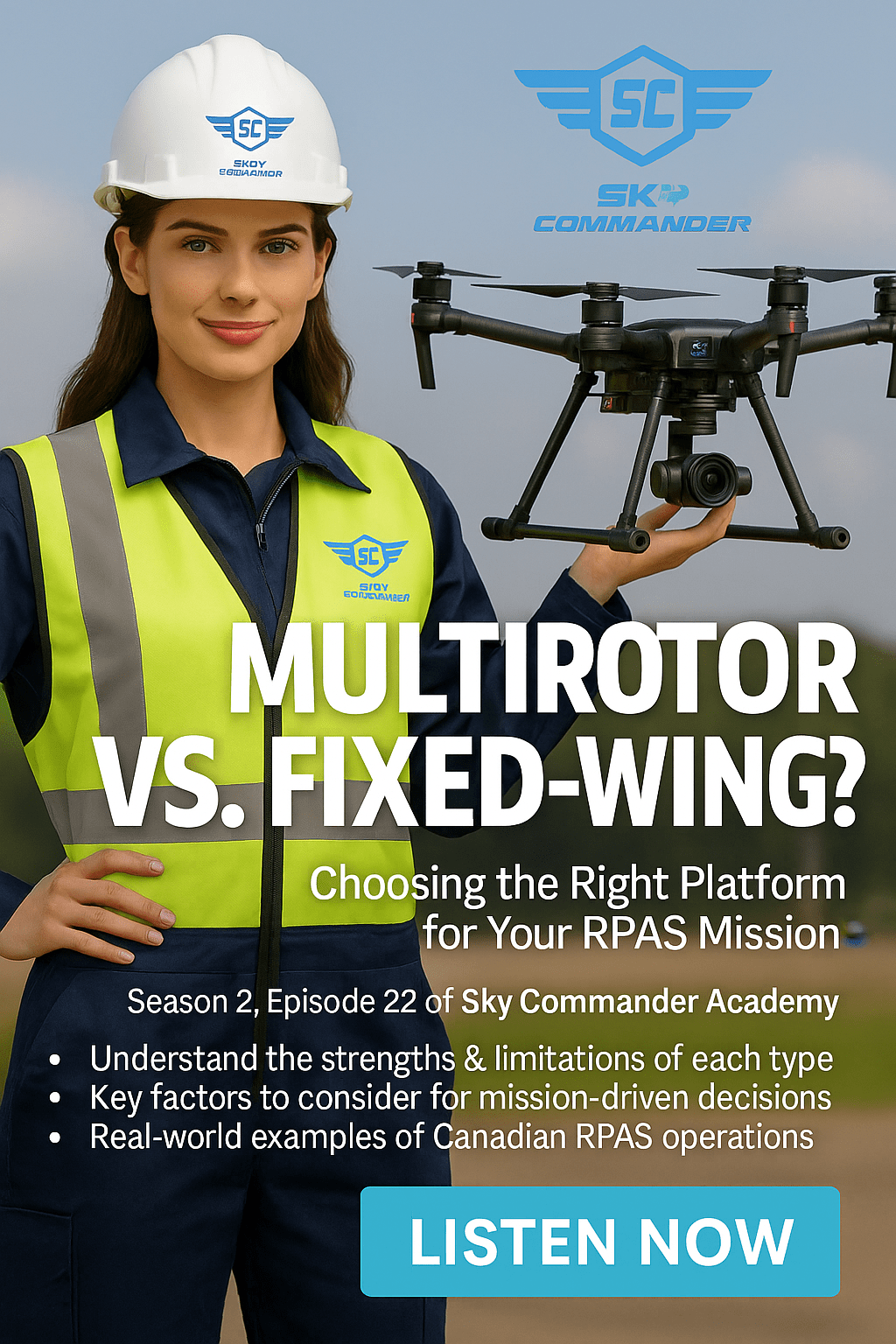
Sky Commander Academy – Season 2, Episode 22 | RPAS Training Series
When it comes to advanced RPAS operations in Canada, selecting your drone platform isn’t about personal preference. It’s about mission alignment, payload needs, airspace limitations, and safety.
In Season 2, Episode 22 of the Sky Commander Academy Podcast, we break down one of the first—and most critical—choices every professional RPAS pilot must face:
🎯 Why This Decision Matters
Multirotor and fixed-wing platforms offer unique strengths—and major trade-offs. Understanding those trade-offs can be the difference between mission success and operational failure.
This isn’t just about flying. It’s about matching the right tool to the right job.
Whether you’re planning a high-res orthomosaic in a tight urban corridor or mapping a vast utility corridor across remote terrain, your platform must align with mission demands, regulatory boundaries, and client expectations.
Below is an original Sky Commander song about Multirotor and fixed-wing:
✈️ Multirotor RPAS: Strengths and Use Cases
✔ Vertical takeoff and landing (VTOL)
✔ Agile and precise in tight spaces
✔ Ideal for inspections, 3D modeling, thermal, and low-altitude cinematics
✔ Smaller training footprint for new pilots
✔ Easier to transport and deploy
But… limited by endurance, speed, and range. Multirotors require frequent battery swaps and are more susceptible to wind drift, making them less efficient for long-range survey missions.
🛩 Fixed-Wing RPAS: Strengths and Use Cases
✔ Long-range efficiency
✔ Higher speed and altitude coverage
✔ Greater battery and payload endurance
✔ Excellent for large-scale mapping and BVLOS operations
✔ Ideal for linear corridor inspections, agriculture, and wildfire reconnaissance
However… fixed-wing platforms typically require more space for launch and recovery, and can be harder to maneuver in confined airspace or dense obstacle zones. They demand more advanced training and operational planning.
📦 Payload Considerations & Centre of Gravity (CG)
Here’s where the conversation gets deeper—and more technical. As discussed in our related content on centre of gravity, different platforms handle weight shifts and payload configurations differently.
A multirotor might show signs of motor strain or yaw instability from an imbalanced side-mount payload. A tail-heavy fixed-wing, on the other hand, could pitch into a stall and crash.
If you’re not factoring CG into your platform decision, you’re flying blind.
🧠 Episode Highlights – What You’ll Learn:
🔹 How multirotor and fixed-wing aircraft perform under different operational conditions
🔹 Where each platform excels—and where it struggles
🔹 Regulatory factors, including airspace, payload, and Transport Canada compliance
🔹 Real-world Canadian RPAS case studies where platform choice made or broke a mission
🔹 How to align your Advanced RPAS Certification prep with your preferred platform
📷 Field-Ready, Mission-Driven
At Sky Commander, we’re building Canada’s most trusted drone training and inspection brand—rooted in real-world performance, technical compliance, and smart operational design.
Whether you’re a contractor, pilot, engineer, or fleet manager, this episode helps you ask smarter questions, make better decisions, and fly with confidence.
🎙️ Click here to listen to the full episode
#SkyCommander #RPASCanada #DroneTraining #Multirotor #FixedWing #DroneFleet #AdvancedRPAS #DroneInspection #TransportCanada #DronePodcast #BVLOS #CentreOfGravity
 Sky Commander – Drone Inspections & Aerial Intelligence
Leave a comment