
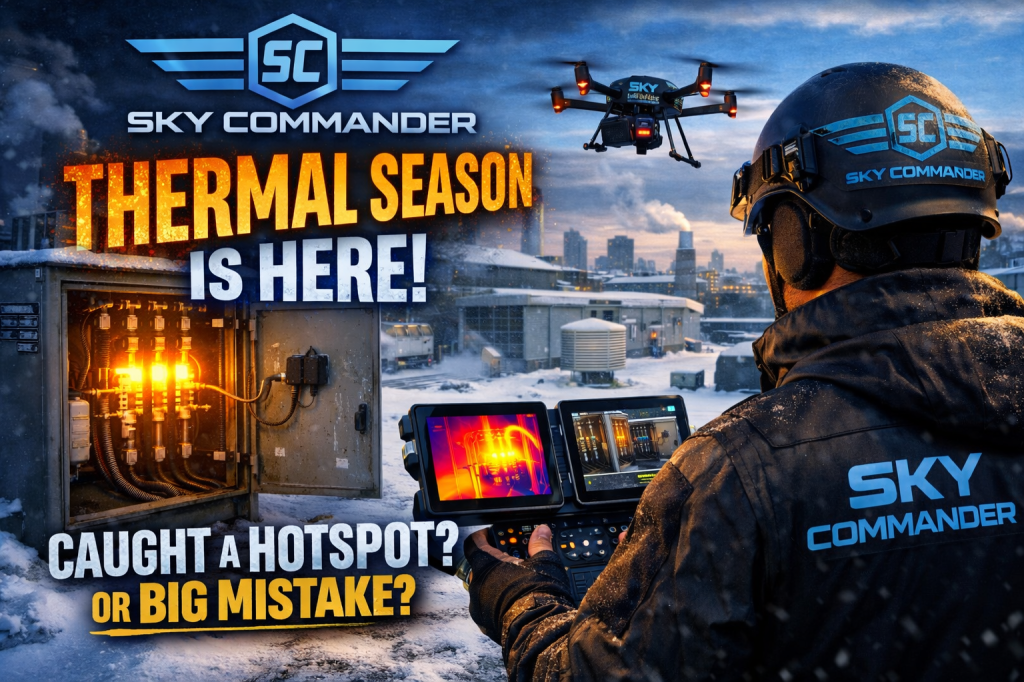
Winter makes infrared feel like a cheat code. It still punishes sloppy pilots.
The most dangerous thermal image is the one that looks obvious.
It’s the one that makes you say, “There. Found it.”
It’s the one that makes a client lean in and start planning a work order in their head.
And it’s the one that can quietly ruin your reputation if you ship it without proof.
Because thermal does this thing where it shows you the truth, then immediately tests whether you deserve it.
The hotspot that tried to embarrass us
A client asked for a “quick thermal pass” on outdoor electrical gear. Nothing had failed. No alarms. Just that gut feeling operators get when something is starting to drift.
First flight, first minute, we saw a bright hotspot on shiny metal. It looked clean. It looked urgent. It looked like a perfect screenshot.
This is the moment where most people accidentally become a tourist.
Tourist move: grab the screenshot, label it “High,” send it off like you just solved the case.
We did the opposite. We did the boring stuff that wins repeat work.
We held the same standoff. We held the angle steady. We paired thermal with a matching visible photo so there was no confusion about what we were even looking at. Then we ran a confirming pass from a slightly different angle.
The hotspot moved.
It slid across the surface like it was following our camera, not the equipment.
That was not overheating. That was reflection.
If we had shipped the first screenshot, it would have turned into a false dispatch, wasted crew time, and a quiet decision to never call us again.
That day, thermal did its job. It revealed something, then tried to trick us. Our method decided what the client got: evidence or theatre.
What thermal really gives you, and what it never will
Thermal cameras detect infrared radiation coming off surfaces and convert it into an image that represents apparent surface temperature patterns.
That word “apparent” matters.
Thermal is not X-ray vision. It does not tell you what is happening inside a connection or inside a wall. It shows you patterns on the surface that often correlate with abnormal behavior.
Winter is prime time because temperature contrast is bigger. Call it delta T, the temperature difference between normal and abnormal. Bigger delta T usually means easier detection. The problem has less room to hide.
If you keep the right expectations, winter thermal is amazing at one thing:
screening and prioritizing.
That’s it. That’s the win.
Where winter thermal actually shines
In the cold season, thermal can help you surface the “go look here first” list.
Electrical work is the obvious one. Abnormal heating at terminations and connectors can show up clearly, especially when you can compare like to like. Phase to phase. Lug to lug. Similar components under similar load.
Building envelope work can also pop in winter, but only when you respect timing and conditions. Heat loss around roof edges, penetrations, and doors often shows patterns that are hard to see in mild weather.
Mechanical is quietly one of the best thermal uses. Bearings, belts, couplings, motors, blocked vents. When one unit runs warmer than its twin under the same job, you have a real lead.
Solar can show hot cells too, but this one is picky. You need the right irradiance and operating conditions. Cold panels help with contrast, but the system still has to be operating in a way that makes anomalies express themselves.
So yes, winter is thermal season.
Now here is the part people skip.
Thermal lies like a professional
Thermal can look convincing and still be wrong.
Reflections are the classic trap. Shiny metal, wet surfaces, glass. Your “hotspot” can be the sky, the sun, or a warm object nearby, reflected back at your sensor. It can move when you move. That is the tell.
Low emissivity is the second trap. Some surfaces do not emit infrared well, so the camera is making a best guess based on poor input. Bare aluminum is famous for looking “cool” even when it is not.
Wind is a stealth thief. Wind cools surfaces and can flatten the very patterns you are hunting. You can fly a perfect route and still miss a real issue because the surface is being cooled faster than it can show the abnormal gradient.
Sunlight can fake patterns. Sun loading warms surfaces unevenly and creates gradients that look like problems. This is why building envelope thermal is so sensitive to timing.
And there is a quiet technical limit most pilots never talk about: resolution and spot size. If you are too far away, one pixel covers too large an area, and your hotspot gets averaged into the background. You did not miss it because you are bad. You missed it because physics did not give you the detail.
This is why the real question is never, “Did you see a hotspot?”
The real question is: could you defend this finding if you were not there?
The five minute brief that turns thermal into evidence
Before you launch, write one sentence. Just one.
What are you trying to find?
Not “scan the area.”
Not “do a thermal pass.”
One sentence that could go into a work order.
“Identify abnormal heating at terminations in cabinet A.”
“Identify heat loss zones along the roof perimeter.”
“Compare bearing thermal patterns across the conveyor drive assembly.”
Now you have a mission, not a flight.
Then do a quick reality check on conditions. Cold is good. Stability is good. Dry surfaces are your friend. Low wind is a gift. Direct sun on the target is your enemy. Wet reflective surfaces are a warning label.
This is also where you choose timing with intent. Buildings often scan best pre-dawn, early morning, or after sunset. Electrical scans are strongest when load is known and stable, or at least comparable. Mechanical benefits from consistent operating state so your comparisons mean something.
Finally, define what “good evidence” looks like before you collect anything.
Here’s the standard that stops arguments later:
thermal plus visible, context, and a confirmation pass.
If you capture that consistently, your reports stop feeling like opinions.
The evidence pack that makes engineers relax
A single thermal screenshot is not a finding. It is a hint.
A finding is a pack. Every time.
First, a thermal close-up of the anomaly.
Second, a matching visible close-up of the exact same component.
Third, a context frame so someone else can locate it without you on the phone.
Fourth, a confirming pass from a slightly different angle to prove it is not reflection or perspective.
Add short notes: conditions, any surface concerns, and an approximate standoff.
That’s it. That’s the pack.
When you deliver like this, something interesting happens with technical clients. They stop arguing about whether you are right. They start talking about what to do next.
The confidence test that separates pros from tourists
Engineers trust you faster when you name uncertainty like an adult.
Use a simple confidence scale and attach a reason.
High confidence means the pattern repeats across angles, peer comparison supports it, conditions are stable, and the surface type is not a known liar.
Medium confidence means the anomaly repeats, but you have a real risk factor: reflections, wind, sun exposure, limited access, or an awkward viewing geometry.
Low confidence means you could not confirm across angles, the surface is reflective or low emissivity, conditions were unstable, or the standoff was too long to resolve detail.
Confidence is not weakness. It is professionalism.
The report format that turns into action, not drama
Clients do not want your entire SD card. They want decisions.
Give them a tight summary first. How many high priority items. How many medium. How many to monitor.
Then give them an anomaly table that bridges directly to maintenance:
Asset and location.
Severity.
Confidence.
Evidence links to thermal and visible.
One line of notes with limitations.
Recommended next step that stays in your lane.
Stay in your lane on next steps. You are not certifying the fix. You are guiding confirmation.
“Recommend inspection and torque check, then re-scan under comparable load.”
“Recommend building envelope follow-up at indicated roof edge.”
“Recommend maintenance inspection and trend re-scan after intervention.”
That is how you become useful.
The safety move that always wins
Thermal does not change the rules.
Do not push proximity to get a prettier image. A safe standoff shot with strong context beats a risky close shot every time. The job is not to be brave. The job is to be repeatable.
This week’s Wingman Challenge
Next time you fly thermal, do not ask, “Did I capture it?”
Ask this instead:
If I was not there, could I defend this finding with what I delivered?
If the answer is yes, you are not filming thermal. You are producing evidence.
 Sky Commander – Drone Inspections & Aerial Intelligence
Leave a comment