
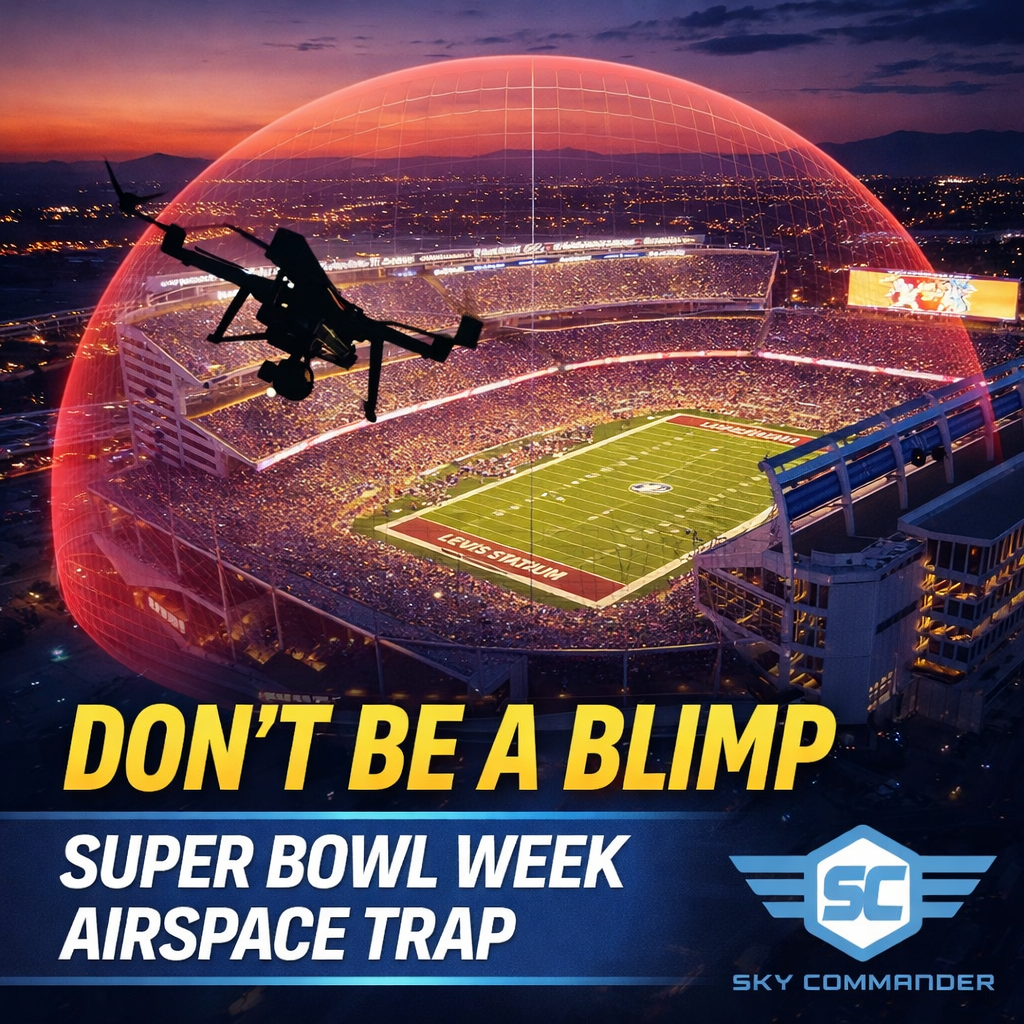
Levi’s Stadium. Santa Clara, California.
Super Bowl LX. February 8, 2026.
If you are thinking “I’ll just grab some quick B roll near the vibe,” this is your Wingman slap on the helmet.
A pilot I know once showed up for “safe” tailgate footage outside a big venue. The plan was clean: stay outside the gates, stay away from people, grab skyline and parking-lot energy, gone in ten minutes. Then the surprise arrived: an aircraft pattern shifted, security posture tightened, and the airspace reality turned out to be bigger than the fence line.
The near-mistake was not bad stick skills. It was a bad assumption.
Super Bowl week is the perfect reminder because it pulls pilots toward exactly the wrong mental shortcut: “I’m not over the stadium, so I’m fine.” The rules do not care about your intent. They care about where you are, when you are there, and what event is happening.
Reports have this year’s matchup as the Seattle Seahawks vs the New England Patriots, which makes the hype even louder and the enforcement even sharper.
Stadium energy creates invisible walls
In the United States, the FAA’s stadium rule is brutally simple: drones and other aircraft are restricted within a 3 nautical mile radius and at or below 3,000 feet AGL around qualifying stadium events, starting one hour before and lasting until one hour after the event ends.
That means the “blimp mindset” fails fast. A blimp floats near the action. A pro pilot plans like the airspace is alive.
The Sky Commander method: treat event flying like a three-layer problem
First layer: published restrictions. In the U.S., you check for the stadium restriction window and any additional TFRs and NOTAMs tied to the event or security posture. The FAA even points you straight at the NOTAM source.
Second layer: operational reality. Event areas attract helicopters, news aircraft, law enforcement, and last-minute movements. Even if you are technically legal, your margin for surprise is smaller than usual. If your launch site is in the wrong spot, crowd flow can crush your plan in seconds.
Third layer: perception and response. A drone near a major event can trigger a security response fast. When that happens, you do not get to explain your artistry. You get to prove your compliance.
Canada check, because “advertised event” rules bite too
If you are reading this from Canada, the principle is the same, even though the wording is different.
Transport Canada is explicit about flying at an advertised event: if you operate within 30 metres of the event boundary, you need an SFOC-RPAS for advertised events. If you are at least 30 metres away from the boundaries, you are not considered part of the event for that requirement.
Also, as of April 1, 2025, microdrones are not a loophole at advertised events. An SFOC is required to fly microdrones at advertised events.
Your planning tool is not your permission slip
Apps are great for awareness, not authority. NAV Drone is clear that it displays relevant NOTAM geozones to help you plan, and it tells you to check the full NOTAM details and comply with the conditions.
If your plan depends on “the map did not block me,” you are already drifting into blimp territory.
The clean win: fly the story, not the stadium
Want the Super Bowl vibe without the airspace headache?
Film the human story away from the protected area: fans arriving, local murals, watch parties, city skyline from a safe distance, sponsor activations with written permission, and calm establishing shots that do not put you inside the invisible wall.
Clients still get excitement. You keep your compliance story clean.
Now close this with the right energy: good luck to the Seahawks and Patriots, and good luck to the pilots who choose discipline over temptation. Fly smart, fly legal, and bring everyone home.
Copyable checklist: Event Airspace Go or No Go
- Confirm the venue and the exact event time window
- Decide if this is a stadium event or an advertised event (or both)
- Pull the authoritative restrictions for the specific date and hour (NOTAMs, TFRs, geozones)
- Draw your own buffer that exceeds the minimum, then build your shot list outside it
- Pick a launch site based on crowd flow and exits, not convenience
- Assign a visual observer whose only job is airspace and crowd scanning
- Set conservative RTH and lost link behavior for dense RF areas
- If hired for the event, get written permission and define your operating perimeter in writing
- Plan a fast abort and pack-up route that does not cross crowds
- If anything is unclear, do not negotiate with yourself, abort early
Short on-site client script
“Because this is a major event, the airspace can be more restrictive than it looks. Before we unpack, we verify NOTAMs, any stadium restrictions, and the exact time window. If we cannot defend the authorization and perimeter in writing, we do not fly. If we can, you get clean footage and a clean compliance story.”
Wingman Challenge
Before your next shoot near a venue, can you show a screenshot or saved note of the authoritative restriction check for the exact hour you plan to fly, and can you explain your buffer in one sentence?
One-line takeaway
If the crowd is big enough to matter, the airspace is big enough to trap you.


Leave a Reply